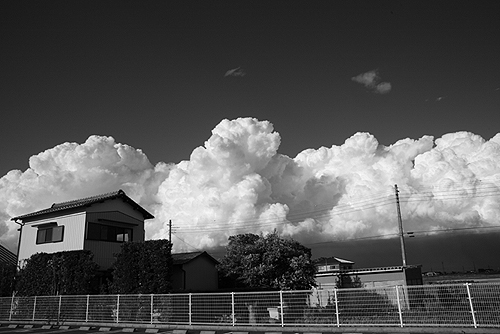
Stieglitz's clouds
I went out as if I got suggestion by somebody. I drove my car. Before long
I saw that the huge thunderhead was growing in the side window. I had not
seen such a perfect thunderhead for long time. It's called "Giant,
or monster cloud" in Japanese. Now I thought it's a perfect name for
the cloud. Then I made sense what God wanted to show me on the day.
The thing which I remember when I saw the thunderhead is the name of Alfred
Stieglitz (1864-1846) American photographer. He made a photo series featured
only cloud in the sky, which was titled "Equivalent" The photo
work is so impressive to me. Therefore I just remember his name as the
photographer of the Equivalent. But he is not only a photographer of the
master piece of cloud's photo but also the great father of American modern
photography.
Stieglitz was born in 1864 at Hoboken, NJ (near NYC) as a child of German-Jewish
immigrant family. His family was rich. Later, the they temporally moved
to Europe. Stieglitz learned mechanical engineering (and also chemistry)
in Berlin. At same time he was interested in photography and traveled around
Europe taking picture with his new camera.
Few years later, the family was back to America. Stieglitz also came back
to home country few years later than his parents. At same time he brought
the theory of fine art photography to America. Photograph had been the
medium for recording until then.
Later, Stieglitz opened his own gallery "Gallery 291" on 5th
Ave. Manhattan. He introduced many European artists like Picasso, Cezanne
and so on, to the American art scene. He himself got married with painter
Georgia O'Keeffe (1887-1986), she also held exhibition at the gallery.
From then on, many portraits of Georgia were shown in his photo works.
In the summer of 1922, when Stieglitz was 58 years old, young critic of
art, novelist Waldo Frank suggested for Stieglitz's works like this. "Power
of his photo is due to the power of individual he photographed" Stieglitz
was disappointed with the criticism.
Coincidentally, in the year his mother was dyeing in the bed. From then
on, Stieglitz got start photographing clouds. He left a comment for the
reason why he started photographing clouds. "The things I want to
express by photo is not subject matter which only privileged people can
touch with, skyline of Manhattan, celebrity's portrait or expensive interior
for instance. No subject matter's important. The things deeper inside is
much important. Therefore from now on I'll shoot just clouds in the sky
to make sure what I've learned in last forty years. Why photographing cloud
and sky? Because the subject matter exist above all the people, whichever
rich or poor, equally"
Since then Stieglitz had photographed hundreds of cloud's photos until
almost his last years. What a strong belief!
The integration of the photos is the series "Equivalent". Gathering
from his story, the title means that all the subject matters are equivalent
in front of camera. And reading one step farther, it means protest to prejudice
for the photography what photo doesn't exist without concrete subject matter.
Maybe he tried to ensure photograph could also make abstractive expression
like other arts, paintings or music for example. So Stieglitz replaced
the emotion for his mother into cloud's photo without putting any exact
data, like place or date. It contained another message of Stieglitz that
photography should be evaluated equivalently as painting or music.
Stieglitz's philosophy to the photography is ideal to me.
However, the photographer taking only portrait of celebrity could not talking
about the "Equivalent" of photography. From the same reason,
the photographer photographing only clouds could not talking about it neither.
Yes, maybe he can. But it's doubtful his story can get a spot light like
the Stieglitz's.
The privileged photographers who could line up both of them side by side
are not so many. Is this my jealous to Stieglitz? Yeah, it could be.
Meanwhile for abstract expression, now a days we know it's possible to
describe abstractive theme through taking picture of concrete subject like
cinema does. However it's in 1920s. If he tried to express the "abstraction"
with same method to painting or music, he must face to difficulty.
With such a struggle in the mind, the old matured photographer spent most
of the time in his last years for aiming camera at sky. It is very fact
that I'm strongly moved.
Jul. 2010
Today's piece
" Thunderhead - Anticipation " Saitama, Japan 2010 |